CHIBA UNIVERSITY · CENTER FOR FRONTIER MEDICAL ENGINEERINGNEURAL SYSTEMS ENGINEERING
OUR RESEARCH

Research projects

Non-invasive neuromodulation, biophysical modeling, stimulation optimization and experimental neurophysiology.

OUR APPROACH

From physical fields to neural responses.

We combine finite-element modeling, neural activation models, experimental measurements and data-driven methods to improve the precision, efficiency and safety of neurostimulation. Projects range from established journal studies to exploratory work in progress.

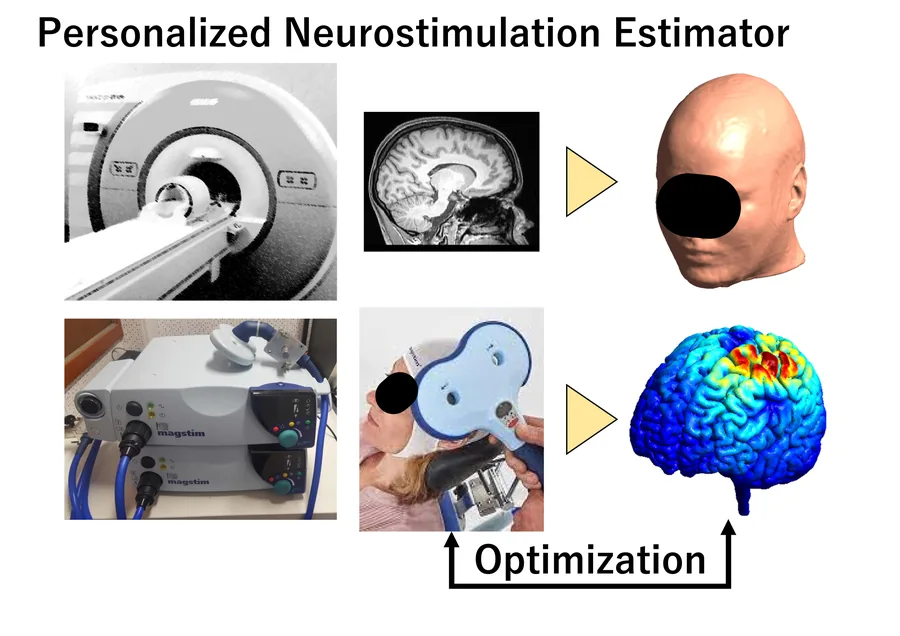
Neuroimaging and personalized neurostimulation optimization figure
Personalized neurostimulation estimation and optimization ↗
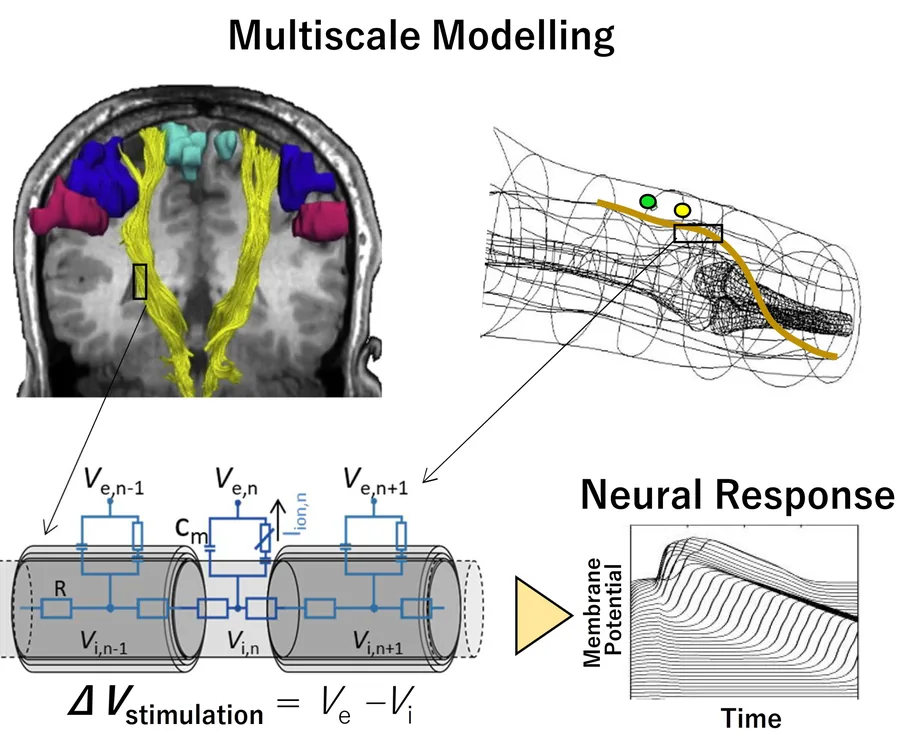
Multiscale neural model diagram
Modeling neural responses across multiple scales ↗
01 / CORTICAL MAPPING

TMS and AI for motor mapping

We combine transcranial magnetic stimulation (TMS), individualized electric-field modeling, input–output curves, motor evoked potentials (MEPs), and deep learning to understand and predict motor-cortex responses. We also quantify mapping reproducibility and coil-orientation effects.

TMS / rTMSMEPDeep learning
02 / DEEP BRAIN & CORTICAL ELECTRICAL STIMULATION

Temporal interference stimulation and tES

Using individualized and population head models, we optimize multi-electrode configurations for deep targets while also studying cortical stimulation with tDCS and tACS. This theme covers focality, conductivity anisotropy, anatomical variability, pain modulation, neural oscillations, and MRI-light personalization strategies.

tTIStDCS / tACSElectrode optimization
03 / SPINAL CORD & ULTRASOUND

Trans-spinal interference stimulation and focused ultrasound

We design stimulation conditions that increase relative field strength at spinal targets while limiting superficial exposure, and we model focused ultrasound propagation, transmission, and heating in cranial and spinal anatomies. Lead-field methods, multi-objective optimization, and safety-oriented simulations are central to this work.

tISCStsFUSField and thermal modeling
04 / PERIPHERAL NERVES

Peripheral nerve activation and conduction control

We study motor and sensory peripheral-nerve stimulation through both experiments and modeling, including kHz interference currents, pulse timing, selectivity, and exploratory conduction-block strategies.

EMG / CMAPkHz currentsMultiscale models
05 / PERSONALIZATION

Personalized modeling, MRI, and AI

We build anatomically detailed electromagnetic and neural models from MRI and diffusion imaging. These simulations support subject-specific stimulation planning, tissue-property reconstruction, and data-driven prediction of neural responses.

FEMMRI / DTIAI estimation
06 / TRANSLATIONAL APPLICATIONS

Rehabilitation and clinical neurotechnology

In collaboration with clinical partners, we explore translational applications such as intraoperative motor-evoked-potential analysis, rehabilitation-oriented neurostimulation, and patient-centered modeling strategies.

RehabilitationIntraoperative MEPClinical collaboration
LABORATORY CAPABILITIES

Methods & resources

Shared numerical and experimental infrastructure supporting multiscale neural engineering.

Modeling & computation

  • Sim4Life and COMSOL Multiphysics
  • SimNIBS and realistic MRI-derived head models
  • Finite-element electric-field and acoustic modeling
  • Neural activation modeling
  • MATLAB, Python and machine-learning workflows

Measurements & experiments

  • Transcranial magnetic and electrical stimulation
  • Neuronavigation and stimulation planning
  • Surface EMG, motor evoked potentials and nerve conduction
  • EEG and electrophysiological measurements
  • High-performance computational workstations

Research areas represent a mix of published, collaborative and in-progress studies. Project descriptions are not claims of clinical efficacy.